Music
How Garba Is Sung: Group Voices, Live Leads and Modern Arrangements
A listening guide to group responses, live singing, devotional compositions and film arrangements, without confusing music with dance-step names.
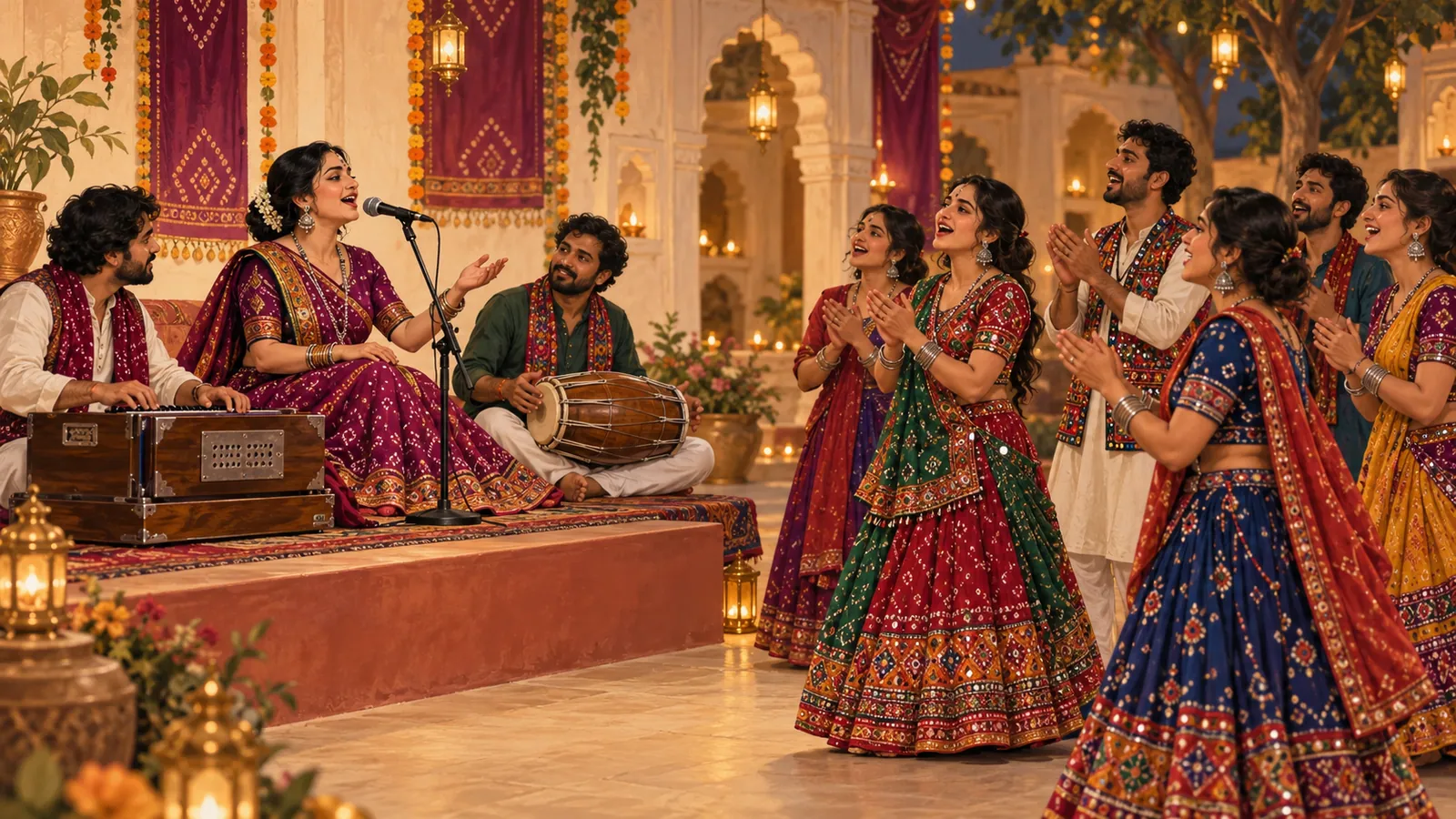
Two recordings can share a familiar tune and still feel very different. One leaves space for a group response; another follows a lead singer’s phrasing; a third builds its energy through a studio arrangement. Listening to those choices can help you understand the music before trying to match the steps.
These are listening approaches, not an official list of fixed Garba genres. They also differ from dance-pattern names such as Be Taali or Tran Taali, which belong in the Garba styles guide.
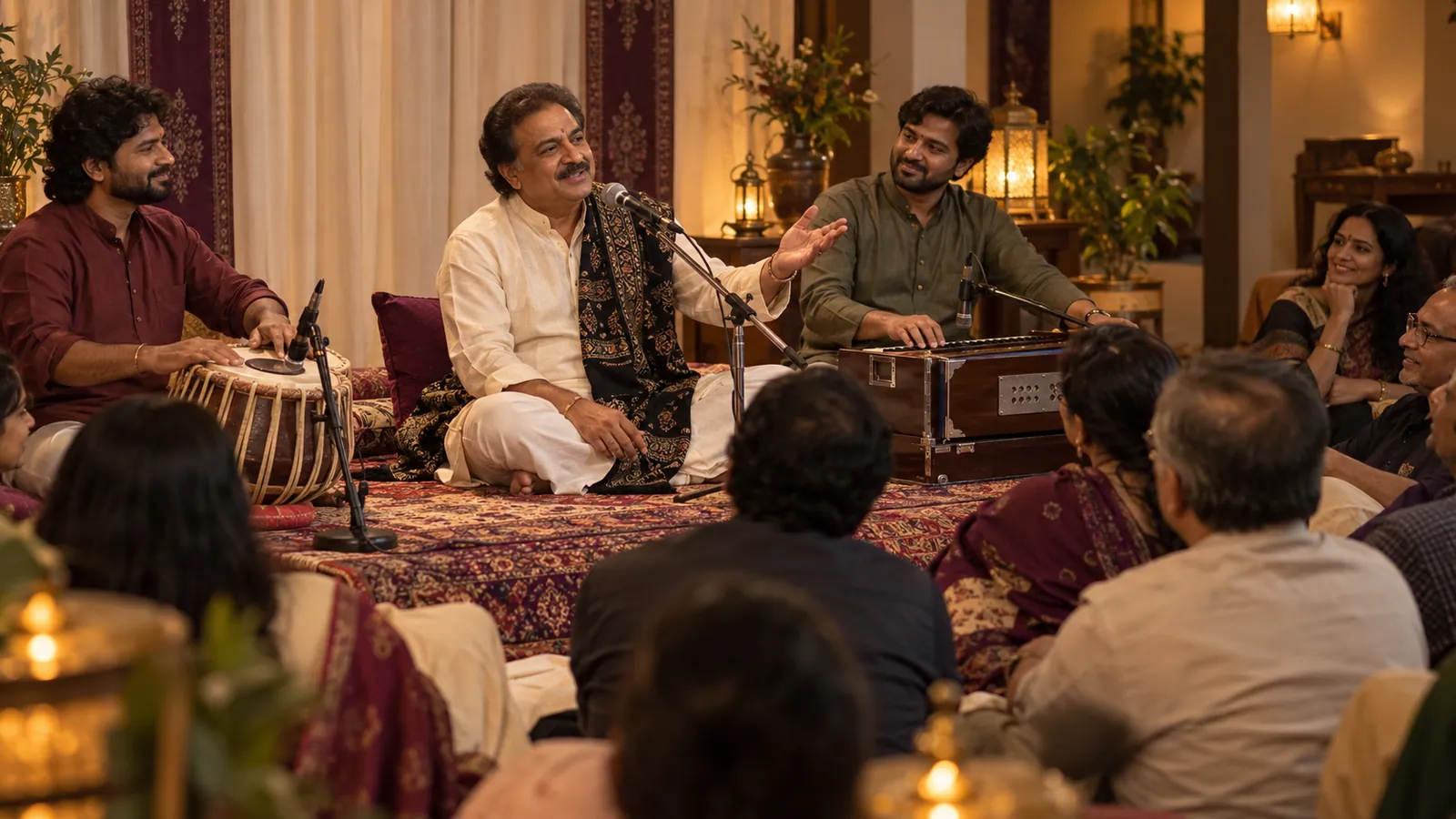
Listen for a voice and an answering group
Medha Yodh’s study describes a singer leading lines that the other participants repeat. It also records an ensemble accompanying dancers and, in another part of an evening, singers in that ensemble taking the lead.S02
The arrangement changes who carries the song. When the group responds, the participants are part of its sound. When an amplified lead guides the round, dancers may follow a voice coming from outside their immediate circle.
Try listening for the end of a line and the next response. Does the group repeat, answer or simply continue moving while the singer carries the passage? This question is useful across recordings without pretending they all follow one pattern.
Separate the song’s subject from its production
“Devotional” describes what a song addresses; it does not tell you whether the recording is old, acoustic or made without a studio. Moti Veraana, for example, is described by its creators as an original Gujarati composition welcoming Goddess Ambika.S14
A film song, meanwhile, may bring Garba imagery into a narrative about its characters. The distinction is worth keeping visible even when both tracks appear at a festive event.
Notice the musicians around the lead
The main voice is only one part of a recording. On Udi Udi Jaye, the label credits live percussion, bass, mandolin, charango and other instrumental work alongside the singers. Its release description frames the song around Uttarayan.S25
That combination is a good reason to avoid judging a track by one instrument or a festival playlist label. Ask what the arrangement does as a whole, and read the credits before declaring that it is a preserved traditional form.
A film arrangement is another listening setting
Speaking about Shubhaarambh, singer Divya Kumar singled out the arrangement and credited Shruti Pathak’s Gujarati lyrics and vocals as part of its character.S21
His comments point towards a practical exercise: listen once for the singers, once for the recurring rhythmic shape and once for how the instruments enter. You do not need to assign a technical taal or raga to enjoy those details. An exact musicological classification needs analysis of the specific performance.
Dayro asks you to listen differently
Dayro belongs to the wider Gujarati performance world, but it should not be treated as a dance pattern. Bhikhudan Gadhvi is associated with its narrative singing tradition.S18
Instead of asking only “Can I dance to this?”, listen to how a performer tells or introduces a story. That shift in attention makes the distinction between an evening of narrative performance and a continuous dance round much clearer.
Choose a version you can actually follow
For practice, select a full recording with a passage you can hear clearly. Avoid assuming that a fast remix teaches the same timing as a slower live version. At an event, watch the circle before joining and let the local pattern guide you.
Explore the playlist for named recordings, and use Garba music for practical advice about following a round.
Credited recordings in this guide
Moti Veraana
Songs of Faith / AT Azaad · Modern devotional Garba composition · Gujarati · Year context 2020
- Performers
- Osman Mir, Amit Trivedi
- Composers
- Jayashri Trivedi, Amit Trivedi
- Lyricists
- Jayashri Trivedi, Amit Trivedi
Udi Udi Jaye
Raees · Gujarati festival-themed film recording · Hindi · Year context 2017
- Performers
- Sukhwinder Singh, Bhoomi Trivedi, Karsan Sagathia
- Composer
- Ram Sampath
- Lyricist
- Javed Akhtar
Shubhaarambh
Kai Po Che! · Film Garba composition · Hindi and Gujarati
- Performers
- Shruti Pathak, Divya Kumar
- Composer
- Amit Trivedi
- Lyricists
- Swanand Kirkire, Shruti Pathak
Shruti Pathak — Gujarati lyrics
Named performer interview; not consistently exposed in platform catalogue.
Sources
- Medha Yodh — Garba: A Social Dance of Gujarati Women, Pacific Review of Ethnomusicology 1 (1984), pp. 65–70. Checked 2026-10-05. ↩
- AT Azaad — Moti Veraana official video, 2020. Checked 2026-10-05. ↩
- Zee Music Company — Udi Udi Jaye official audio. Checked 2026-10-05. ↩
- The Times of India — Singers discuss Shubhaarambh and other Navratri songs, 2022. Checked 2026-10-05. ↩
- Akashvani News — Aaj Savere bulletin, Bhikhudan Gadhvi entry. Checked 2026-10-05. ↩