Music
Before the Big Stage: Voices That Shaped Gujarati Garba
Meet Avinash Vyas, Hemu Gadhvi, Diwaliben Bhil and other influential voices without reducing Garba’s community history to a single pioneer.
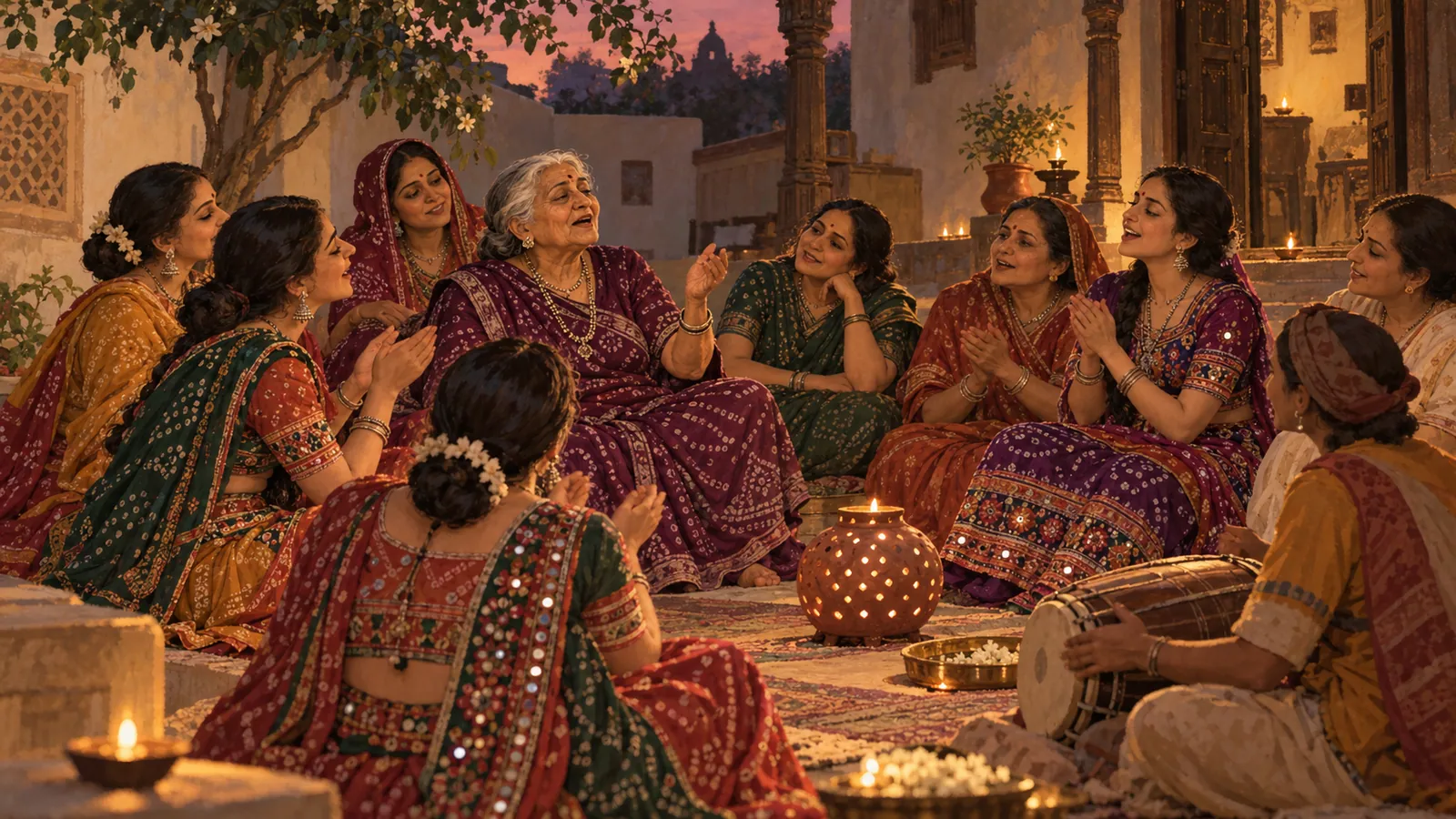
Ask who pioneered Garba singing and the answer begins beyond the recording studio. Families and neighbourhood groups kept songs in circulation before an audience could buy a named singer’s album. The famous voices matter, but the circle matters too.
UNESCO describes Garba as a devotional dance associated with Navratri in Gujarat. Its recognition concerns a living practice sustained by communities. It does not name a founder of Garba music.S01
The singers whose names were not on a sleeve
In her 1984 study, Medha Yodh described a woman leading a song and the group repeating each line. Singing was one way participants learned the repertoire while dancing.S02
That account helps explain why “Who sang it first?” can be difficult to answer. A documented recording may be much younger than the song or performance practice it preserves. A named performer can make a version familiar without becoming the author of every element in it.
Avinash Vyas: composition belongs in the story
Avinash Vyas was a composer, lyricist and singer whose work extended across Gujarati light music and cinema. The NCPA’s 2023 retrospective included a Garba sequence within a programme of his songs.S03
His place here is different from that of a lead singer on a festival stage. He represents the work of composing and writing: shaping music that other people can record, remember and perform. A history framed only as a succession of singers would miss that contribution.
Hemu Gadhvi: folk music, theatre and broadcasting
Hemu Gadhvi brought Saurashtra’s folk repertoire into theatre, public performance and radio. Gujarati Vishwakosh describes his engagement with Raas, Garba, folk songs, duha and chhand, along with his work at Akashvani in Rajkot.S04
Rather than calling him the inventor of Garba, it is more useful to see him as an influential carrier and interpreter of a wider folk tradition. His example connects the stage to the spoken and sung literature around it.
Diwaliben Bhil: a voice learned through life
Diwaliben Bhil was a self-taught folk singer. Reporting after her death described her singing Garba in Junagadh and learning folk songs from her mother. Those details place her music within everyday transmission as well as public recognition.S05
The Government of India’s 1990 notification lists her for the Padma Shri in folk songs.S06 Her story also gives women’s voices a central place in an account too easily dominated by the names on recent concert posters.
Praful Dave: the folk and cinema connection
Praful Dave connects Gujarati folk performance with playback singing. In a 2011 interview, he recalled recordings involving Avinash Vyas and discussed Maniyaaro as part of his musical journey.S11
That connection shows how the categories overlap. Film studios could give folk voices another platform, while performers continued to work beyond cinema. It would be misleading to treat folk, playback and live Garba as three sealed histories.
Think in contributions, not a single crown
These are selected influential figures, not a complete list of the people who sustained Gujarati music. Poets, collectors, accompanists, local singers, organisers and dancers also belong in the larger account. Acknowledging that wider world does not diminish a celebrated artist; it explains what makes their work possible.
Follow the story into Mumbai and Falguni Pathak’s live circuit, or explore Dayro and the art of listening to folk narratives.
Sources
- UNESCO — Garba of Gujarat. Checked 2026-10-05. ↩
- Medha Yodh — Garba: A Social Dance of Gujarati Women, Pacific Review of Ethnomusicology 1 (1984), pp. 65–70. Checked 2026-10-05. ↩
- NCPA — Avinashi Avinash, programme for 6 October 2023. Checked 2026-10-05. ↩
- Gujarati Vishwakosh — Hemu Gadhvi, by Hasmukh Baradi. Checked 2026-10-05. ↩
- The Indian Express — Gujarat: Popular folk singer passes away at 75, 20 May 2016. Checked 2026-10-05. ↩
- Government of India — Padma Awards notification, 26 January 1990. Checked 2026-10-05. ↩
- The Times of India — Youngsters come to listen to me: Praful Dave, 21 July 2011. Checked 2026-10-05. ↩